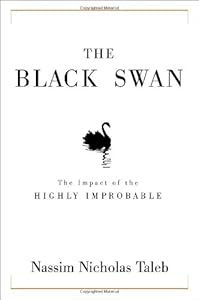
I've been reading The Black Swan by Nassim Nicholas Taleb and this sequence of posts (see below, beginning here, and there's one more after this) are inspired by this book. Taleb show us the limits to reason. The predictive power of reason is poorer than those who loudly promote reason claim.
This is no reason to abandon reason. The paradox is reason can show us its own limitations. Some theologians have of course known this all along.
So, what can't we know? We can't know the future. This is the nature of chaos theory, small incidents have big consequences. It's not that we can't observe the small causes; we don't know which ones are important. I see a butterfly flap its wings. I know this movement could in theory cause a hurricane on the other side of the world, but how can I prove it was this particular butterfly at that particular time? And what if the cause is the interaction between many butterflies?
We ignore non-linearities. This bothered me for years as a scientist. We use logarithms to turn non-linearities into linearities and so end up with a graph with a straight line. Nothing wrong with this, except we easily forget it isn't linear.
Ecumenical conversations are subject to the same issues. How can we be sure the rational debates of the theologians are taking us any closer to unity? How can we know the significant is not to be found amongst certain local churches, for example, rather than in the conversations between church leaders. Some local partnerships might have a massive impact on the future of the churches, but which ones?
Formal conversations can overlook the consequences of success. If the Church of England moves closer to the Roman Catholic Church, for example, what are the implications for its relationships with the Methodist and Reformed traditions? And of the relationship between the Roman Catholic Church and the Orthodox, for that matter?
Christian unity is multi-factorial (just like everything else) and so cannot be approached in an entirely ordered way. The consequences of initiatives are always unpredictable. This is not to deny the positive achievements of formal conversations, they have established massive theological common ground.
It's the small things that keep tripping up the churches. The barriers to unity are not theological, they are about human beings and their organisations.






Recent Comments